
Water Scavengers
Vinyltrimethoxysilane (VTMO) | Manta V31
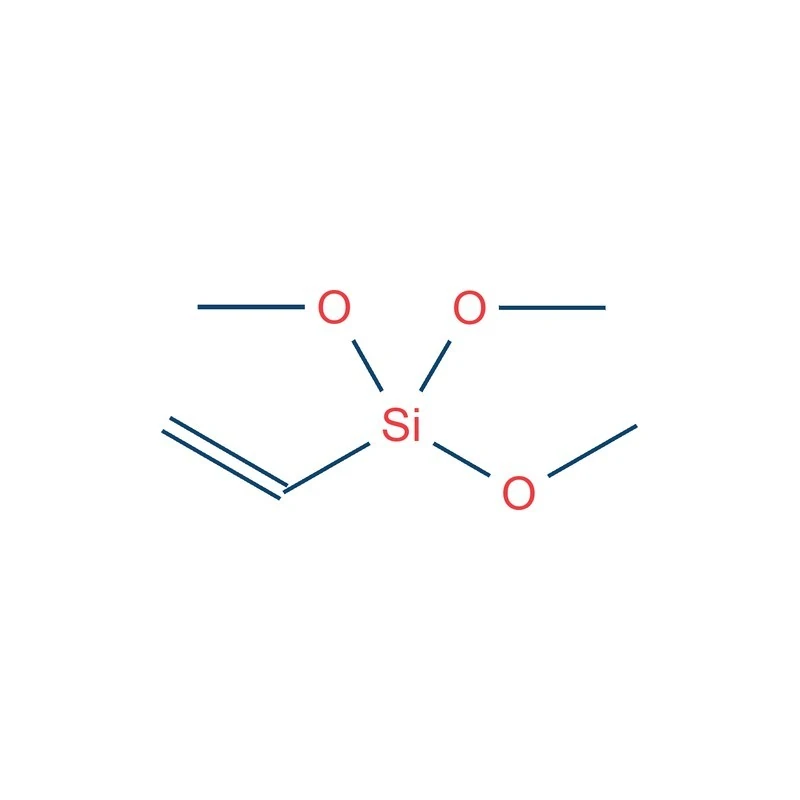
Manta V31 is vinyltrimethoxysilane (VTMO, CAS 2768-02-7), a bifunctional organosilane used for moisture crosslinking of polyethylene in wire, cable and PEX pipe production and as a moisture scavenger in one-part sealants. It also serves as a co-monomer for water-borne emulsions and as a surface modifier for flame-retardant fillers.
- Grade
- V31
- Chemical Name
- Vinyltrimethoxysilane(VTMO)
- CAS No.
- 2768-02-7
- Formula
- C5H12O3Si
- Form
- Colorless Transparent Liquid
Overview
Manta V31 is a bifunctional organosilane with a reactive vinyl group and a hydrolyzable trimethoxysilyl group. The vinyl group binds to polymers through radical grafting, while the silyl group forms a moisture-curable crosslinked siloxane network.
Its main use is the moisture crosslinking of polyethylene (XLPE) for wire, cable and PEX-b pipe. Compared with uncrosslinked polymer, silane crosslinking raises the maximum continuous use temperature and improves creep resistance, environmental stress crack resistance, impact strength, abrasion resistance and chemical resistance.
In one-part moisture-curing sealants V31 reacts rapidly with water and consumes trace moisture during compounding and packaging. Where the scavenger should also extend the polymer chain and keep modulus low, compare the alpha-functional dialkoxy grade Manta AM121. V31 releases methanol on hydrolysis.
Key Features
- Vinyl group grafts to polymers through peroxide-initiated radical reaction
- Trimethoxysilyl group forms a moisture-cured Si-O-Si network
- Rapid reaction with water for moisture scavenging in one-part formulations
- Copolymerizes with acrylic and vinyl acetate monomers
- Improves filler dispersion in highly filled polymer composites
- Releases methanol on hydrolysis
Cross-Reference
Manta V31 can be considered as an alternative to Momentive Silquest A-171, Evonik Dynasylan VTMO, Wacker GENIOSIL XL 10 and Shin-Etsu KBM-1003.
Trademarks are the property of their respective owners; no affiliation is implied.
Specifications
| Property | Typical Value |
|---|---|
| Appearance | Colorless Transparent Liquid |
| Density (ρ20°C, g/cm³) | 0.960–0.980 |
| Refractive Index (n25/D) | 1.3880–1.3980 |
| Purity (by GC,%) | 98min |
Typical values from the current Technical Data Sheet.
Applications
- Wire, cable and PEX pipes: silane grafting and moisture crosslinking of polyethylene and other polymers for cable jacketing, wire insulation and PEX-b pipes
- Adhesives and sealants: moisture scavenger in one-part MS polymer, polyurethane and silicone formulations, improving shelf life and helping to limit premature gelation or outgassing in the cartridge
- Water-borne coatings: co-monomer with acrylic or vinyl acetate monomers in emulsion polymerization, improving wet scrub resistance, weatherability and crosslinking density
- HFFR cables: surface modifier for aluminum trihydroxide (ATH) and magnesium hydroxide (MDH) fillers, improving filler dispersion, water resistance and mechanical strength
- Specialty resins and composites: adhesion promoter and coupling agent for unsaturated polyester and acrylic resin systems, and sizing agent for fiberglass composites
Related applications: Adhesives & Sealants · Paints & Coatings · Composites & Fiberglass · Wire & Cable
Packaging & Storage
Supplied in 20 kg pail, 190 kg drum and 950 kg IBC.
Safety and Storage
Keep away from heat and open flame. When stored at or below 25°C in the original unopened containers, this product has a usable life of 24 months from the date of production (200L drum).
Documents
- Technical Data Sheet · PDF Download TDS
- SDS and COA · on request Request Documents
Frequently Asked Questions
How does silane crosslinking of polyethylene with Manta V31 work?
Using a peroxide initiator in an extruder, the vinyl group grafts onto the polymer backbone. The shaped product, such as cable jacketing or PEX-b pipe, is then exposed to moisture or hot water, and the trimethoxysilyl groups hydrolyze and condense into a crosslinked Si-O-Si thermoset network.
Why is Manta V31 added as a moisture scavenger in one-part sealants?
Because it reacts rapidly with water, V31 consumes trace moisture during compounding and packaging of MS polymer, polyurethane and silicone formulations. This improves cartridge shelf life and helps to limit premature gelation or outgassing.
What advantages does silane crosslinking have over peroxide or radiation methods?
It requires lower capital investment and energy costs, offers higher productivity with wider processing latitude and control of premature crosslinking (scorch), accommodates complex shapes and variable thicknesses, works with heavily filled composites and applies to all PE densities and copolymers.
Can Manta V31 be copolymerized into water-borne emulsions?
Yes. Its vinyl group copolymerizes with acrylic or vinyl acetate monomers during emulsion polymerization, producing silane-modified water-borne dispersions with improved wet scrub resistance, weatherability and crosslinking density on drying.
Which flame-retardant fillers does Manta V31 treat for HFFR cables?
It surface-modifies aluminum trihydroxide (ATH) and magnesium hydroxide (MDH) used in halogen-free flame retardant cables, improving filler dispersion, water resistance and mechanical strength in highly filled compounds.
Related Products
V31 is one step in the sealant and adhesive formulation chain. One inquiry can cover the other raw materials in your formulation, with samples, technical documents, quotation and shipment handled together.
Looking for a different purity, functional group, or a structure not listed here? Contact our technical team.
Talk to our technical team
Tell us your application, target properties and estimated quantity. We will suggest grades and arrange documents or samples.